
Abu Simbel Sun Festival Myths: Alignment Truths
Myths About the Abu Simbel Sun Festival: Ancient Engineering or Modern Hype?
Twice a year, sunlight pierces the darkness of an ancient Egyptian temple, illuminating statues in a breathtaking display—welcome to the Abu Simbel Sun Festival. This bi-annual event draws thousands to witness the sun’s rays align perfectly with Ramses II’s inner sanctuary, sparking wonder and myths about its origins.
Is it a supernatural phenomenon or precise astronomy? In this post, we’ll debunk common misconceptions about the Abu Simbel Sun Festival, exploring its history, engineering, and cultural significance. From what happens twice a year at Abu Simbel to why Abu Simbel is famous, you’ll get the facts behind the hype.
By the end, you’ll see it’s a testament to ancient ingenuity—let’s shine light on the truths.
The Origins of the Abu Simbel Sun Festival Myths
Where Did These Myths Come From?
The Abu Simbel Sun Festival traces back to the 13th century BCE, when Ramses II built the temples to honor himself and the gods. The structures were aligned with the sun on his birthday and coronation (October 22 and February 22).
Myths grew in the 1960s during the UNESCO relocation project to save the temples from flooding by Lake Nasser. The alignment shifted by about one day, leading to claims that the temple’s “magic” had been disturbed. By the 1980s, tourism promotions began presenting the event as supernatural, overlooking its astronomical basis.
In 2025, a large portion of visitors travel specifically for this event, while social media continues to amplify miracle-like narratives. Similar solar alignments at sites such as Stonehenge or Mayan temples have also generated comparable myths worldwide.
The Cultural and Tourist Appeal
These myths persist because the event feels divine. A 2023 UNESCO report highlights the festival’s importance in preserving Egyptian heritage while supporting modern tourism.
Myth 1: The Sun Alignment Is a Supernatural Phenomenon
What Is the Abu Simbel Festival Really?
Some believe the alignment is mystical, as if gods “activate” the temple. In reality, the Abu Simbel festival is an astronomical achievement. Ancient engineers positioned the temple so that sunlight travels nearly 200 feet into the inner sanctuary twice a year.
During this event, the light illuminates statues of Ramses II, Amun, and Ra, while the statue of Ptah remains in shadow, symbolizing the underworld.
Research confirms that the alignment was calculated using the solar calendar of the Nile civilization. The event occurs on February 22 and October 22, and the illumination lasts about 20 minutes. The phenomenon reflects mathematical planning, not supernatural forces.
Engineering Behind the “Miracle”
The sunlight effect is the result of human design. The temple’s orientation and facade angle were carefully planned. When the temple was relocated in 1968, the alignment was preserved, though the date shifted slightly due to geographical adjustments.
Myth 2: The Festival Is a Modern Invention for Tourists
Abu Simbel Sun Festival Dates and Access
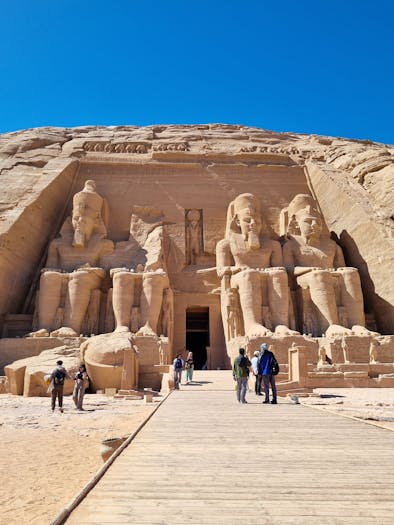
Another common myth suggests the festival was created recently to attract tourists. Historical evidence shows that ancient Egyptians celebrated solar events linked to royal anniversaries and religious ceremonies.
Today, the event remains open to all visitors with standard temple entry. The festival still occurs on February 22 and October 22, close to Ramses II’s historical dates.
Ancient records and archaeological research confirm that solar worship ceremonies existed long before modern tourism. The modern celebration reflects a continuation of traditional solar symbolism rather than a commercial invention.
Festival Traditions and Food
During the event, local communities often gather and celebrate. Visitors may experience traditional Egyptian foods such as koshari (a lentil and rice dish) and sweets like basbousa, combining cultural hospitality with the festival atmosphere.
Myth 3: The Alignment Is Perfect and Unchanged
What Happens Twice a Year at Abu Simbel?
Twice a year, sunlight enters the temple and illuminates three statues for about 20 minutes. However, the alignment is not perfectly unchanged.
Originally, the event occurred on February 21 and October 21. After relocation, the dates shifted slightly. Additionally, Earth’s axial movement causes gradual astronomical changes over long periods.
The temple was originally oriented about 60 degrees east to achieve the effect. Restoration work has ensured visibility, but the idea of eternal perfection is exaggerated.
Why Is Abu Simbel Famous?
Abu Simbel is famous not only for the Sun Festival but also for its massive rock-cut statues and its successful rescue by UNESCO in the 1960s. While myths add mystery, its true significance lies in ancient engineering and cultural heritage.
Practical Tips for Experiencing the Abu Simbel Sun Festival
Planning Your Visit
Book early for February 22 or October 22, as demand is high.
Arrive early, ideally before sunrise, since the temple opens at dawn and viewing spots fill quickly.
Wear comfortable and modest clothing suitable for Egypt’s cultural norms.
Take time to explore nearby Lake Nasser to understand the relocation project and its historical importance.
Avoiding Tourist Misconceptions
Be cautious of tours that promote exaggerated or mystical explanations. Official guides and historical resources provide accurate information. Understanding the historical purpose—honoring Ramses II—will enhance the experience.
Conclusion
The Abu Simbel Sun Festival combines ancient engineering with natural astronomy. Myths about supernatural origins or modern fabrication often overshadow the true achievement behind the phenomenon.
What happens twice a year at Abu Simbel is a reminder of human precision and scientific understanding. The site is famous because it represents the ingenuity and vision of ancient Egyptian civilization.
While myths add intrigue, the real story is even more impressive. Plan your visit and experience this remarkable example of ancient knowledge and cultural heritage.
Frequently Asked Questions
What is the Abu Simbel festival?
It is a bi-annual solar event during which sunlight illuminates statues inside the temple on February 22 and October 22. The alignment was designed to honor Ramses II’s legacy and royal anniversaries.
What is the Sun Festival?
The Sun Festival is an astronomical phenomenon where sunlight lights three statues inside the temple, symbolizing divine power and renewal in ancient Egyptian culture.
What happens twice a year at Abu Simbel?
Sunlight reaches the inner chamber and illuminates statues of Ramses II, Amun, and Ra for about 20 minutes. The event reflects precise architectural planning rather than a supernatural occurrence.
Why is Abu Simbel famous?
It is known for its massive rock-cut temples dedicated to Ramses II and Nefertari, as well as the UNESCO relocation project that saved the site from flooding.
What is the meaning of the Sun Festival?
The festival symbolically celebrates Ramses II’s divine authority and represents rebirth, solar worship, and the importance of astronomy in ancient Egyptian culture.